
The Nima gluten sensor disappeared for a few years, and now it’s back. A new company relaunched it in January 2026 with new funding, a redesigned device, and a claim that it can now detect gluten at 10 parts per million. Searches for it have exploded since, and if you have celiac disease, you’ve probably wondered whether a $220 gadget could finally take the guesswork out of eating out.
The honest answer is “sometimes, and with limits.” Here’s what the Nima actually does, what it costs, where it falls short, and what the major celiac organizations think of it.
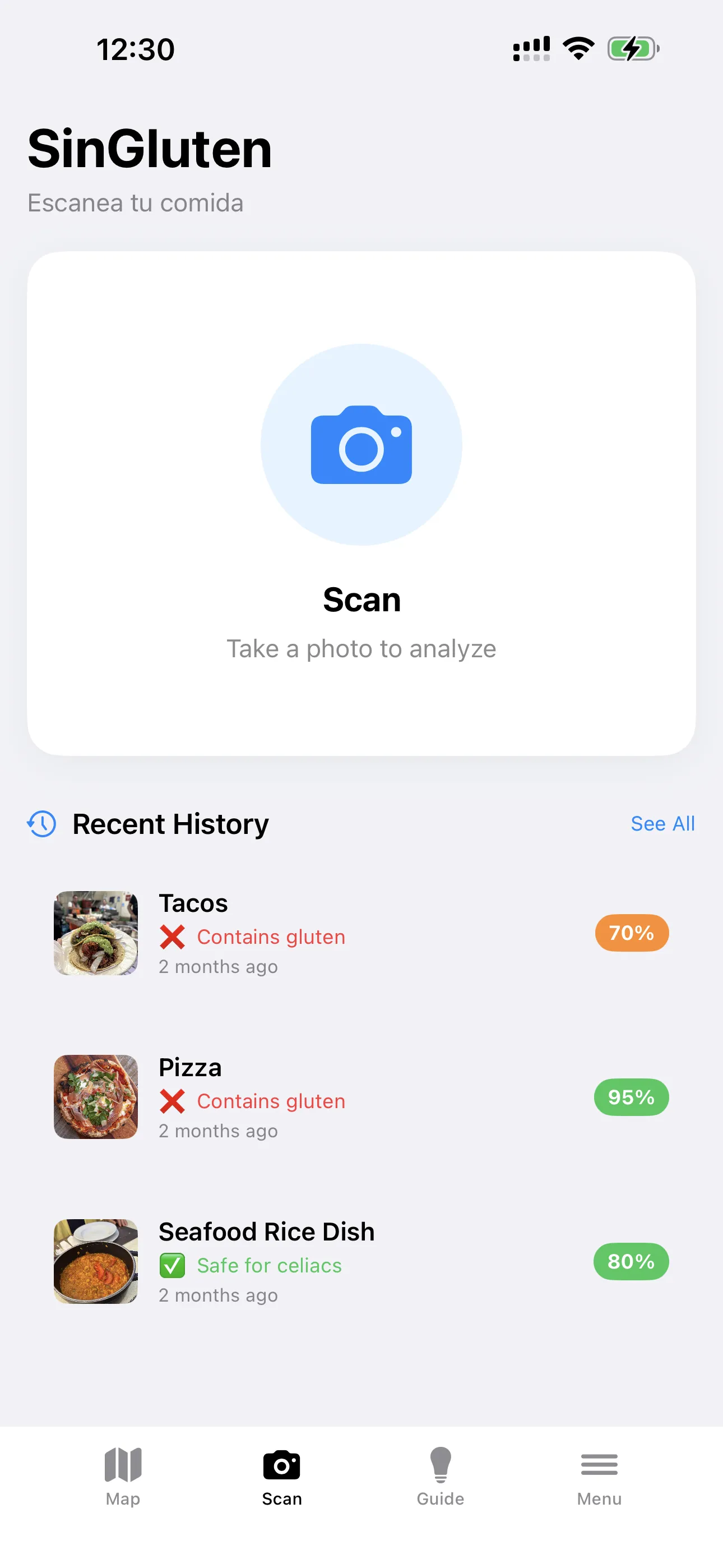
One disclosure up front: we make GF Scanner, a different kind of tool. A gluten sensor tests a bite of food. Our app checks ingredient labels and maps verified gluten-free restaurants. They do different jobs, and we’ll be clear about where each one fits.
Want to check packaged food in seconds, without capsules? GF Scanner reads the barcode and ingredients for you.
Get GF Scanner →Table of contents
Open Table of contents
Is the Nima sensor back?
Yes. The original Nima went off the market after ownership changes and pandemic supply problems. In January 2026 it relaunched under a new company, with backing that includes RA Capital. The company says the new sensor was rebuilt from the ground up. It detects gluten from all the major grains at levels as low as 10 ppm (the original was rated at 20 ppm), has a claimed 99% accuracy, and now connects to an app. In April 2026 it also won a Stevie Award for product innovation.
How the Nima sensor works
The process is the same as before:
- You put a pea-sized piece of food into a single-use capsule.
- You screw the capsule into the sensor. It grinds the sample and mixes it with a solution that contains gluten-binding antibodies.
- About three minutes later you get a result. A smiley face means no gluten was detected above its threshold. A wheat icon means gluten was found.
It’s small enough to carry in a bag, so you can test a dish at the table before you eat it.
How much the Nima costs
At the time of writing (fall 2026), prices on the official store are:
| Item | Price |
|---|---|
| Sensor (includes 1 capsule) | $220 |
| Starter Pack (sensor, extra capsules, cable, travel bag) | $330 |
| Capsules, 6-pack | $72, or $61.20 with a subscription |
That works out to roughly $10 to $12 per test. If you eat out several times a week and test every meal, the capsules become the real cost, not the device.
What the Nima can’t do
These limits matter more than the accuracy number, because they decide when a result is actually useful.
It can’t test soy sauce or alcohol. Fermented and hydrolyzed foods break gluten into fragments the sensor can’t reliably detect. That’s a big gap, because soy sauce is one of the most common hidden sources of gluten. (If you want to know where else gluten hides, see our hidden gluten guide.)
One bite doesn’t represent the whole plate. Cross-contact is uneven. A few crumbs from a shared toaster or a splash from a shared fryer might land on one part of a dish and not another. A clean result from a pea-sized sample tells you about that sample, not the meal.
Low levels are the hardest to call. Even with a lower threshold, results close to the cutoff are less certain. That’s exactly the range where cross-contact usually lands.
It doesn’t replace asking. A sensor can’t tell you whether the kitchen uses a dedicated fryer or whether the “gluten-free” pasta was cooked in shared water.
What celiac organizations say
The major celiac groups are skeptical, and it’s worth knowing why.
- Gluten Free Watchdog, the independent US testing organization, does not recommend the Nima. Its concerns are about the original device’s data. That data showed the sensor missed gluten at 20 ppm more than 20% of the time, and that a single pea-sized sample can’t represent a whole serving. It has said it doesn’t plan an in-depth assessment of the relaunched version.
- Celiac Canada’s scientific advisory board does not recommend using the Nima to decide whether a food or meal is gluten free.
The company’s own validation for the new version is more positive, but independent testing of the 2026 sensor is still limited. The fair way to read all of this: the Nima is one extra data point, not a safety guarantee.
The safest meal is one from a kitchen you checked before you sat down. Find 100% gluten-free restaurants near you.
📲 Get GF Scanner on the App StoreWho the Nima is actually for
The Nima makes the most sense if you:
- Eat out often at restaurants that aren’t dedicated gluten-free kitchens, and want a second check on a dish the server says is safe.
- Are highly sensitive and willing to spend $10 or more per meal for extra reassurance.
- Are a parent of a child with celiac disease and want one more check at birthday parties, school events, or relatives’ houses.
It makes less sense if you mostly eat at home, mostly eat packaged food, or mostly eat at dedicated gluten-free restaurants. In those situations you’re paying per test for information you can get more cheaply in other ways.
Other gluten detectors and test kits
The Nima isn’t the only option, but it’s the only well-known portable sensor.
Home gluten test kits like EZ Gluten and GlutenTox Home use test strips, similar in principle to a lab test. They take more steps and more time than the Nima, so they’re better for checking an ingredient or a packaged product at home than for testing a meal at a restaurant table.
Lab testing is the gold standard, but it takes days and costs much more. It’s what manufacturers and groups like Gluten Free Watchdog use, not something you do before dinner.
Gluten sensor vs. scanner app: which do you need?
These two tools get compared a lot, but they solve different problems.
| Nima gluten sensor | GF Scanner app | |
|---|---|---|
| What it checks | A bite of prepared food | Packaged food labels and ingredients |
| Time per check | About 3 minutes | A few seconds |
| Cost per check | About $10 to $12 per capsule | No per-check cost |
| Soy sauce | Can’t detect it | Flags it in an ingredient list |
| Finding a safe restaurant | No | Yes, a map of verified gluten-free spots |
| Best moment to use it | At the table, before you eat | In the grocery aisle, or before you choose where to eat |
In practice, a lot of people with celiac disease use both. They use an app to choose where to eat and to check packaged food, and a sensor as an occasional extra check on a restaurant dish they’re unsure about.
The bottom line
The 2026 Nima is a real improvement on paper, and for frequent restaurant eaters it can add useful peace of mind. But it can’t test soy sauce, it can’t see cross-contact it didn’t sample, and celiac organizations still advise against treating a smiley face as proof a meal is safe. Treat it as one more check, not the only one.
The cheapest and most reliable protection is still choosing the right kitchen before you order. That’s what we built GF Scanner to do.
Sources
- The NIMA Gluten Sensor Is Back. Here’s What Changed (Allergic Living)
- NIMA Partners introduces the next-generation NIMA gluten sensor (GlobeNewswire)
- NIMA Gluten Sensor product page (official store)
- Gluten Free Watchdog’s updated position statement on the Nima Sensor
- Celiac Canada’s statement on the NIMA Gluten Sensor
Check food in seconds, not minutes.
GF Scanner checks packaged food labels instantly and maps verified gluten-free restaurants near you. No capsules, no per-test cost.
📲 Download GF Scanner on the App Store