
Ask a room full of celiacs where to go on vacation and you’ll get a near-instant, near-unanimous answer before anyone even finishes the question: Italy. Then, a beat later, a flood of other answers — some predictable, some genuinely surprising — depending on who’s in the room.
That’s basically what happened when someone asked exactly this in a celiac community forum before a trip: any destinations with great gluten-free options, willing to go anywhere. Over a hundred people answered. Patterns showed up fast, and so did a few wildcards nobody puts in the standard “top 10 gluten-free destinations” listicle. Below is what that crowd actually said, organized so you can use it instead of just admiring it.
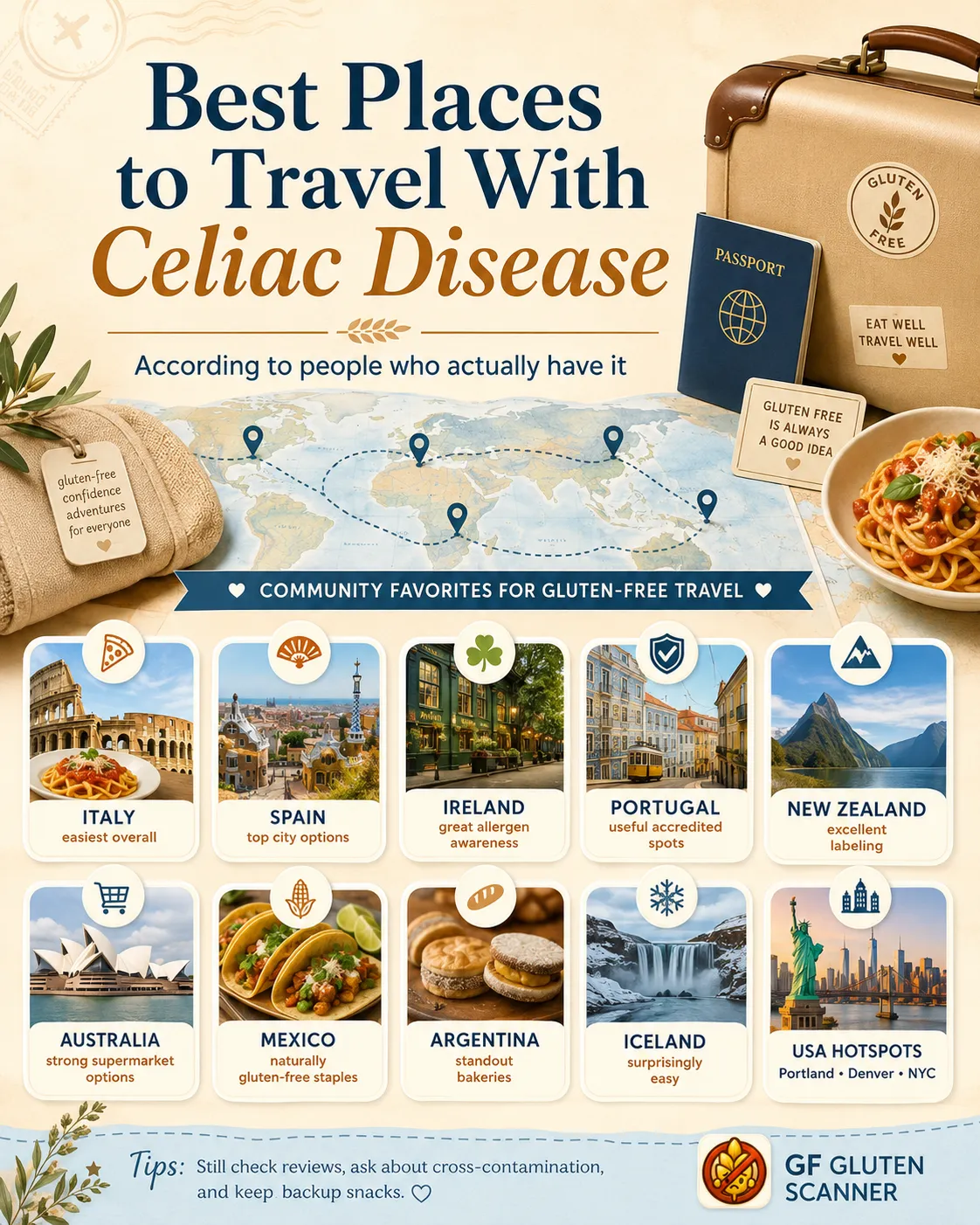
Table of contents
Open Table of contents
- Italy: yes, it’s actually that good
- Spain: the one that surprises people
- Ireland: great in cities, more homework outside them
- The quiet European bench: Hungary, Malta, Portugal, Iceland
- New Zealand and Australia: the long-haul payoff
- Latin America: where the cuisine does the work for you
- Asia: harder, but more doable than its reputation
- If you want zero decisions: cruises, resorts, and Disney
- Closer to home: US cities worth knowing about
- The part the highlight reels skip
Italy: yes, it’s actually that good
If there’s one thing the celiac internet agrees on without exception, it’s this one. The reasons come up over and over: no upcharge for gluten-free dishes, mom-and-pop restaurants that can accommodate you just as easily as upscale ones, and a level of staff awareness that’s hard to find elsewhere. One traveler who lived there gluten-free for two years before celiac was even well understood in the US said the magic phrase “sono celiaca” got her accommodated everywhere — grocery stores, pharmacies, restaurants, all without drama.
There’s an actual reason behind this, not just good luck: Sardinia and Sicily have some of the highest celiac rates in the world due to a smaller historical gene pool, and Italy has screened schoolchildren for celiac disease for years. Combine high awareness with a national health system that subsidizes gluten-free food, and you get a country where “gluten free” isn’t a niche request — it’s a routine one.
A few honest caveats worth knowing before you book:
- Venice and Cinque Terre are noticeably harder than Rome, Florence, or Siena — more tourist-driven kitchens, less of the dedicated infrastructure
- Northern Italy in general is slightly more work than central and southern regions
- Fast food chains carry gluten-free options too — yes, including McDonald’s and Burger King, if you want a low-stakes meal on a travel day
For city-by-city picks in Rome, Milan, Florence, Venice, and Naples, see our gluten-free Italy guide.
Spain: the one that surprises people
Spain doesn’t get talked about as much as Italy, but the people who’ve actually been are just as enthusiastic. Barcelona and Madrid come up constantly — dedicated gluten-free bakeries and restaurants within walking distance of each other, supermarkets with a real gluten-free aisle, and yes, McDonald’s locations there serve gluten-free buns with a separate prep area. One traveler described searching “gluten free restaurant” in Madrid and getting real results across every category: burgers, sushi, pasta, all with proper handling.
Valencia and Seville show up too, slightly behind the two biggest cities but still considered easy. If your trip is food-driven, Madrid edges out as the local favorite among repeat visitors, mostly for the sheer density of options and how reasonably priced everything is compared to Italy.
Ireland: great in cities, more homework outside them
Ireland has one of the highest documented celiac rates in the world, and it shows in how restaurants handle it — allergens marked clearly on menus, pubs included, and a level of casual fluency around the condition that catches American visitors off guard in a good way.
The one consistent caveat, interestingly, comes from people who actually live there: cities are genuinely easy, but the more scenic rural stretches lag behind. If your itinerary is Dublin and Galway, you’re in good shape. If you’re road-tripping through small towns along the coast, call ahead or lean harder on supermarket shopping (Tesco’s gluten-free range is solid) for the stretches in between.
The quiet European bench: Hungary, Malta, Portugal, Iceland
These don’t get the headline treatment Italy and Spain do, but they came up enough to be worth listing.
Budapest, Hungary has a cluster of dedicated gluten-free and lactose-free restaurants concentrated in the Jewish Quarter, with allergens marked clearly across the board — a city where you can walk out of your hotel and have several safe options within a few blocks without much planning at all.
Malta gets recommended specifically as the more affordable, English-speaking alternative to Italy — a former British colony, so language is a non-issue, with better beaches and a layered history spanning ancient ruins to WWII sites, at a lower price point than its Mediterranean neighbor.
Portugal (Lisbon and Porto especially) has an accredited-restaurant list run by the Portuguese celiac association, which takes a lot of the guesswork out if you check it before you go.
Paris, France is the one most people don’t expect. The city of the baguette has more than two dozen fully dedicated gluten-free kitchens, including bakeries like Copains and Chambelland that make real croissants. Our Paris guide has the full list.
Iceland surprises almost everyone who tries it. One traveler who went just weeks after diagnosis expected to struggle and instead found that nearly every restaurant offered a gluten-free option — including a hotel that reheated a gluten-free breakfast for her each morning without being asked twice.
New Zealand and Australia: the long-haul payoff
If you’ve got the travel budget and time for a long-haul trip, this pairing comes up again and again as genuinely underrated. New Zealand in particular gets specific, enthusiastic detail: clear allergen labeling in restaurants, gluten-free pastries and baked goods at cafés good enough that one traveler bought boxes of them at every stop on a road trip, and — this one’s oddly specific but comes up often — gluten-free tortillas that actually hold together, which is rarer than it sounds.
Australia gets similar praise, with Coles supermarkets singled out for clear labeling and a solid range of packaged gluten-free snacks. Between the two, several travelers noted New Zealand edges out as slightly more accommodating overall, though both are a long flight from nearly everywhere, so this pairing works best as a dedicated multi-week trip rather than a quick getaway. For city-by-city picks, see our guides to Auckland and Melbourne, which has one of the densest clusters of 100% gluten-free kitchens anywhere.
Scanning menus and packaged food on every trip? Skip the guesswork.
📲 Get GF Scanner on the App StoreLatin America: where the cuisine does the work for you
This is less about dedicated gluten-free infrastructure and more about a simple fact: a lot of Latin American cooking is built on rice, corn, beans, plantains, and cassava rather than wheat, so you’re not constantly working against the menu.
Mexico comes up a lot, with Cabo specifically recommended as low-stress — corn tortillas are the norm there rather than wheat ones, most people speak enough English to navigate a translation card if needed, and there’s even a specialty grocery store in the area stocked with familiar gluten-free brands for when you want something predictable.
Argentina, especially Mendoza, gets some of the most enthusiastic specific praise in this whole list — multiple dedicated bakeries and restaurants, staff who know what they’re doing even outside the major cities, and what more than one traveler called the best gluten-free bread they’ve had anywhere.
Chile gets a simpler endorsement: a lot of standard Chilean restaurant food just happens to be naturally gluten-free without anyone trying.
Asia: harder, but more doable than its reputation
Soy sauce is the problem across most of East and Southeast Asia, because standard versions are made with wheat. That makes Asia a step up in difficulty, but each of the big travel cities now has dedicated gluten-free kitchens worth building a trip around.
- Tokyo has a cluster of 100% gluten-free restaurants and bakeries, including one that serves gluten-free ramen, tempura, and okonomiyaki. See our Tokyo guide.
- Bangkok is easier than people expect, because Thai food runs on rice and rice noodles. The risk is in the sauces. See our Bangkok guide.
- Seoul is the hardest of the three, since gochujang and Korean soy sauce usually contain wheat, but it has dedicated bakeries and a gluten-free pizza place. See our Seoul guide.
If you want zero decisions: cruises, resorts, and Disney
Not everyone wants a trip built around researching restaurants, and there’s a whole category of travel that exists to remove that work entirely.
Cruises split opinion more than anything else on this list, mostly because experience varies a lot by cruise line. The strongest endorsement came from a traveler managing over 20 food allergies who gets assigned a dedicated personal chef for the entire cruise on Royal Caribbean — call ahead of time, get a special dietary order set up, and head straight to the dining room on boarding day to meet with the head chef directly. Other lines got more mixed reviews, so this is very much a “which cruise line” question, not a blanket “cruises are safe” one.
All-inclusive resorts can go either way, but one specific example stood out: Anse Chastanet in St. Lucia, where the executive chef personally walks guests through the buffet on theme nights, gluten-free items are plated and served separately from the self-serve sections, and one highly sensitive traveler described feeling as safe there as eating at home — a rare claim for a resort buffet.
Disney World gets its own specific shoutout, separate from resorts generally — clearly marked menus, a dedicated allergy-ordering process at table-service restaurants, and staff who are visibly used to handling it. (Disneyland Paris reportedly does not have the same reputation, for what it’s worth.) If Universal is on the same Orlando trip, our Orlando guide covers which park restaurants run dedicated fryers.
Closer to home: US cities worth knowing about
Not every trip needs a passport. A handful of US cities came up repeatedly as genuinely easy:
- Portland, Oregon — frequently the first answer for domestic travel, with one of the more active local gluten-free community groups around
- Denver, Colorado — recommended alongside the broader Colorado mountain towns if you want scenery with your meal
- Burlington, Vermont — a smaller-city pick that surprised more than one visitor with how much was available
- Nashville, Tennessee — most barbecue is naturally gluten-free, and even smaller local spots reportedly understood what “highly sensitive” meant without much explanation
- New York City — slightly more legwork than the others on this list, but the depth of dedicated restaurants once you find them makes it worth the planning (we’ve got a full breakdown of NYC’s safest spots if that’s where you’re headed)
The part the highlight reels skip
Here’s the honest caveat that doesn’t fit neatly into a “best of” list: even the best country on this list still requires some homework. The traveler who loved Rome and Florence still ran into trouble in Cinque Terre. The Irish local who vouched for Dublin warned that rural stops needed more advance planning. Even people who’d had a flawless week of restaurant meals in Spain or Italy still mentioned having a backup plan — a grocery store run, a few bars in a bag — for the one meal that didn’t go as expected.
That’s really the throughline across every recommendation here: the best celiac-friendly destinations aren’t the ones where you never have to think about food. They’re the ones where, when you do think about it, the answer is usually yes. Pick a place from this list that matches your risk tolerance and your idea of a good trip, do a little research before you land, and let everyone else’s hard-won experience save you the trial and error.
Double-checking a packaged snack or local product while you’re away? GF Scanner scans a barcode and tells you in seconds if it’s celiac-safe — handy in a supermarket aisle anywhere on this list.